


Airbourne - Airbourne

Updated: Sep 3
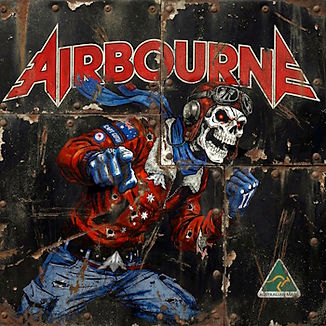
After two decades of proving that rock ’n’ roll doesn’t need to be reinvented to remain dangerous, the Australian hard rockers Airbourne are back with their sixth studio album, Airbourne, due out September 4, 2026, via Spinefarm Records. The band have returned to the fundamentals: loud guitars, bigger riffs, shouted choruses, reckless momentum, and songs built to be played at ear-splitting volume in front of a sweaty crowd. If the band's message throughout their career has been “keep the rock alive,” Airbourne feels like their definitive declaration that they never stopped believing in it.
The album’s most revealing moment, however, comes before the first riff even hits. In his heartfelt message to the late Lemmy Kilmister, frontman Joel O’Keeffe recalls the Motörhead legend’s advice to the band: stay true to yourselves, ignore the industry noise and make music your roadies will love. Six years of writing, rewriting, discarding songs and searching for the gold ultimately produced an album that was subjected to the most important test Airbourne could imagine: their crew loved it. It’s easy to understand why.
From the opening seconds of “Gutsy,” Airbourne comes roaring out of the gates with the kind of unpretentious, four-to-the-floor rock that has become the band's calling card. There’s no lengthy introduction and no attempt to ease the listener in. The guitars are immediate, the rhythm section hits hard, and O’Keeffe sounds like he’s still trying to out-scream the amplifiers behind him.
“Alive After Death (Last Plane Out)” adds an emotional weight that Airbourne’s usual beer-soaked, knuckle-dragging rock ’n’ roll rarely requires. Inspired by the experience of returning to the road and finishing lyrics away from the studio, the song is also the album’s clearest connection to Lemmy. Rather than becoming a solemn tribute, it carries the spirit of someone refusing to stay down. It’s loud, defiant, and celebratory—a fitting way to honour someone who spent his life insisting that rock ’n’ roll should never apologize for itself.
“Here She Comes” and “Kid In A Candy Store” restore the band's mischievous swagger, while “Sky High” pushes the record toward fist-pumping arena-rock territory. Airbourne have always understood that a great hard-rock song doesn’t necessarily need complexity; it needs a riff you remember after one listen and a chorus you can scream after three beers. These tracks operate on precisely that principle.
That simplicity never feels accidental, though. The album's lengthy gestation becomes apparent in the songwriting. Airbourne spent years chiselling these songs down, collaborating with figures including Bryan Adams and Mutt Lange before bringing in Brian Howes, and eventually working with producers and engineers including Mike Fraser and Karl Dicaire. The result is a record that sounds meticulously constructed without losing its barroom grit.
That balance is particularly evident in “Who Put The Rhythm In You?”, one of the album’s most infectious cuts. It’s cheeky, swaggering, and built around a groove that feels almost impossible to resist. “Christmas Bonus” brings another shot of personality to the record, while “Last Man Standing” sounds like a title tailor-made for Airbourne: stubborn, battered, and still standing with the amps turned all the way up.
The production deserves plenty of credit as well. Recorded in Australia amid hurricanes, flash floods, malfunctioning tape equipment, and a studio environment populated by everything from snakes to spiders, the circumstances could hardly have been more chaotic. Yet that chaos seems to have worked in the band's favour. The use of vintage Neve consoles associated with the Australian rock tradition gives the album an appropriately gutsy foundation, while Zakk Cervini’s mix and Ted Jensen’s mastering provide enough punch and polish to make the record hit with modern force.
Importantly, Airbourne never sounds like a band desperately attempting to recreate the past. It sounds like a band that knows exactly which parts of its past are worth keeping.
The album's ninth track “Rock ‘N’ Roll Ya” is practically the band's mission statement in complete song form, while the tune “Bogotá” injects another burst of globe-spanning road-warrior energy. “Hells Got No Vacancy” continues the album’s unapologetically larger-than-life attitude, and the album's final track “Send Me To Rock ‘N’ Roll Heaven” closes the record with a title that could scarcely be more appropriate. A homage to all of rock and metal's greats who have passed on to “Rock ‘N’ Heaven.”
There are moments when Airbourne can feel deliberately familiar. The band isn't interested in genre deconstruction, unexpected electronic textures, or reinventing the hard-rock formula. But that's precisely the point. At a time when so much music is obsessed with novelty, Airbourne have spent years refining something much more difficult: authenticity. They sound like themselves, while rounding out their edges.
And after six years of work, Airbourne sounds like the album they wanted to make rather than the album they were expected to make. There are no concessions here, no attempts to chase whatever happens to be fashionable. Just guitars, drums, sweat, volume and the enduring belief that a great rock song can still be enough.
Perhaps the greatest compliment is that Lemmy would probably recognize the spirit of it immediately.
Airbourne took his advice. They shut the doors, ignored the noise, wrote until they found the gold, and then played the finished product for the people who had heard them more than anyone else—the roadies. They loved it. So will anyone who still believes rock ’n’ roll should be loud, dangerous and a hell of a lot of fun.
Check out more from Airbourne:


Comments